Fujifilm X-E5 as a Full-Frame Replacement

The Disappointing Sony A7C
More precisely, I was disappointed with the full-frame format. I had admired the concept of carrying over the 35mm film format into digital, and I was also swayed by the well-known saying that “you start with APS-C and later move up to full-frame — that’s the standard path.” So for nearly a year, I used a full-frame camera as my first main camera. But actually using it revealed so much inconvenience that it was startling.
Large Sensor, Large Lenses
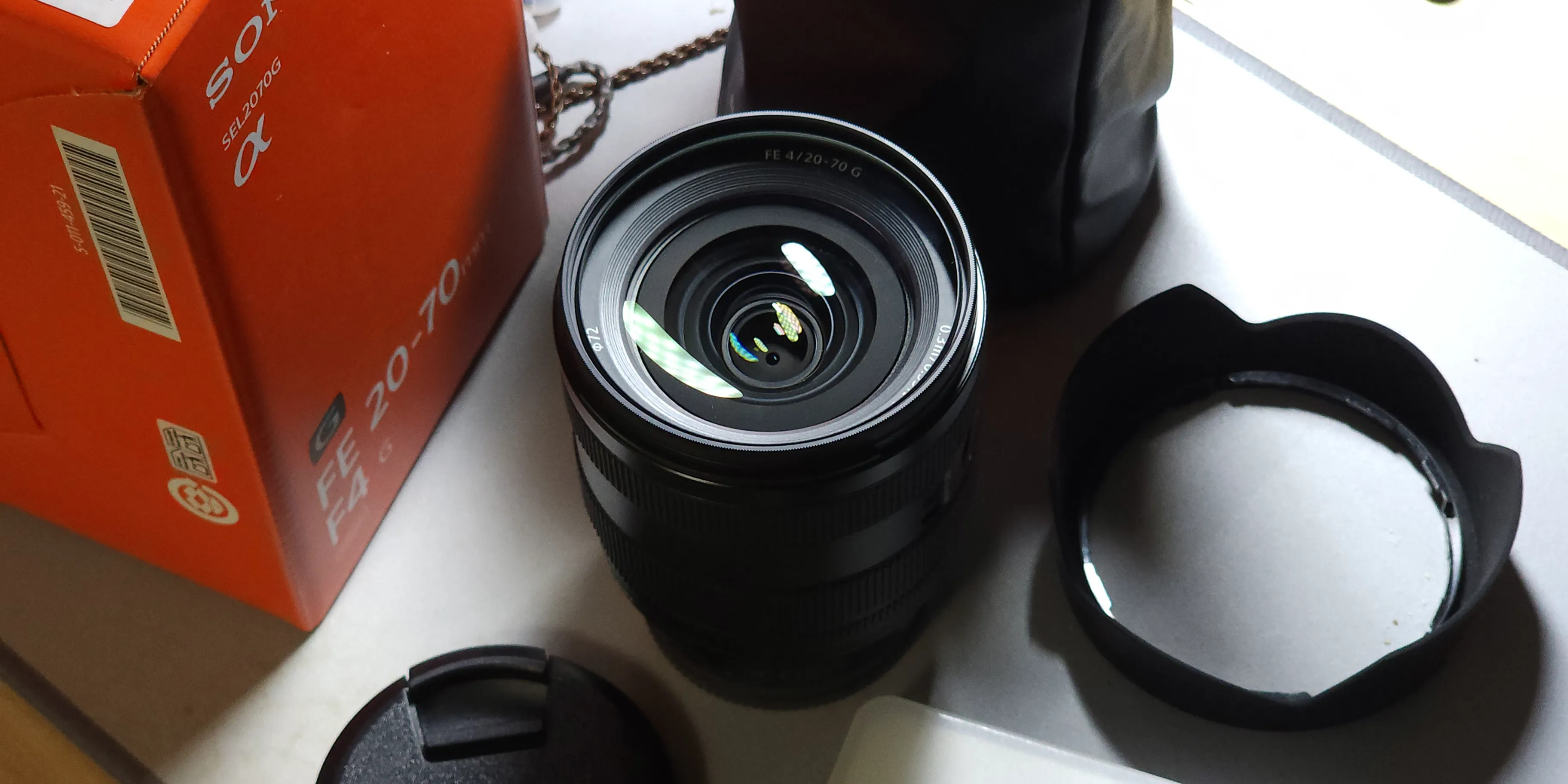 The SEL2070G lens that has since left my hands
In my case, my biggest motivation for getting a camera was to casually snap photos during everyday activities like travel. But even the SEL2070G, considered a lightweight zoom lens, was too heavy by my standards. Paired with the A7C, the center of gravity was off — the camera’s front tilted forward awkwardly, and every step I took, the body’s corner jabbed into me uncomfortably. I ended up seriously doubting whether I could travel with this combination at all.
Possible alternatives include the SEL2860, a trio of primes including the SEL35F28Z and SEL40F25G, and options like the Viltrox AF 50mm F2 Air, TTArtisan AF 40mm F2, or Samyang Remaster Slim series. But each of these requires significant compromises in light gathering, vignetting, bokeh quality, and so on. This dilemma arises fundamentally because large sensors demand large lenses.
On the other hand, zoom lenses praised for unlocking the potential of Sony full-frame — like the SEL2470GM2 or SEL2870GM — and primes like the SEL35F14GM, SEL50F14GM, SEL85F14GM2, as well as third-party options like the Sigma 24-70mm F2.8 DG DN or Tamron 28-75mm F/2.8 Di III VXD G2, are all expensive and heavy. The price I could somehow accept, but the weight is irremediable.
Moreover, these lenses are structurally aligned with commercial photography needs — studio, wedding, video production — and they invest space and weight in engineering refinement through aspherical and low-dispersion elements. From this perspective, full-frame lenses may see incremental improvements going forward, but nothing groundbreaking — they’ll stay more or less the same.
Engineering Disappointments
While researching hardware characteristics and image processing elements — Bayer patterns, photodiodes, ISPs, demosaicing — to understand smartphone camera specs, I naturally became curious: “Just how much better is a full-frame camera?” But after using one myself, I’m skeptical. I’m not convinced it needs to be full-frame. In general, the advantage of a larger image sensor comes from securing full well capacity (FWC), and the resulting benefits are essentially two:
- Improved signal-to-noise ratio (SNR)
- Improved dynamic range (DR)
The key question is how much benefit you get relative to the weight and bulk expended. The most intuitive example: over the past three years, I’ve felt that even a smartphone camera like the Galaxy S22 Ultra can take impressive photos. Noise isn’t an issue in well-lit conditions, and even when it is, AI denoising handles it well enough. So the one advantage a large sensor exclusively holds is DR — and even that isn’t terribly critical in everyday conditions, and can be compensated for with HDR merging in static environments.
Emotional Disappointments
If that’s the case, the raison d’être of a camera shifts away from pragmatism toward the feeling of owning a camera itself, or the unique shooting experience that cameras offer. That’s why I recently looked into manual lenses like the ZEISS Loxia 2/35 and 2/50 that could bring obsession and personality to the shooting experience — I even got close to buying one before giving up, feeling that it wasn’t a fundamental improvement, and a bit frustrated about it.
The reason is simple. The experience of using the Sony A7C wasn’t engaging enough. The more I used it, the more the Sony camera gave me the impression that it’s focused on efficiency, engineering completeness, and commercial viability — rather than the joy of taking photos. But the whole pipeline of shooting, developing .DNG raw files on a computer, and sharing them felt like a forced obligation. Color grading is certainly an enjoyable extension of the photo-making process, but having that workflow repeat itself felt a bit exhausting.
A Good Deal Appeared
While I was feeling skeptical about the Sony A7C, I found a listing on a secondhand marketplace last October: an X-E5 with around 300 shutter actuations, a TTArtisan 27mm F2.8 lens, and other accessories — all for 1.9 million won. Since I could get essentially a new item at a bargain price, I contacted the seller immediately. When I met the seller and inspected the item closely, it was spotless — including a transparent skin, screen protector, soft shutter button, and black mist filter. I asked the seller why they were selling it at this price, and they said:
“I’m using a Canon full-frame and this felt too different — didn’t suit me. Couldn’t be bothered, so I listed it cheap.”
They took it pretty coolly. They seemed somewhat older (in age), and my guess is that they might have found the Fujifilm camera physically flimsy and toy-like compared to its recent reputation, which led them to the opposite opinion from mine. Whatever the reason, it was a great opportunity for me to get something that’s hard to find even when you want it, at good terms. I listened to the seller’s notes and instructions before completing the transaction.
First Impressions of the Fujifilm X-E5
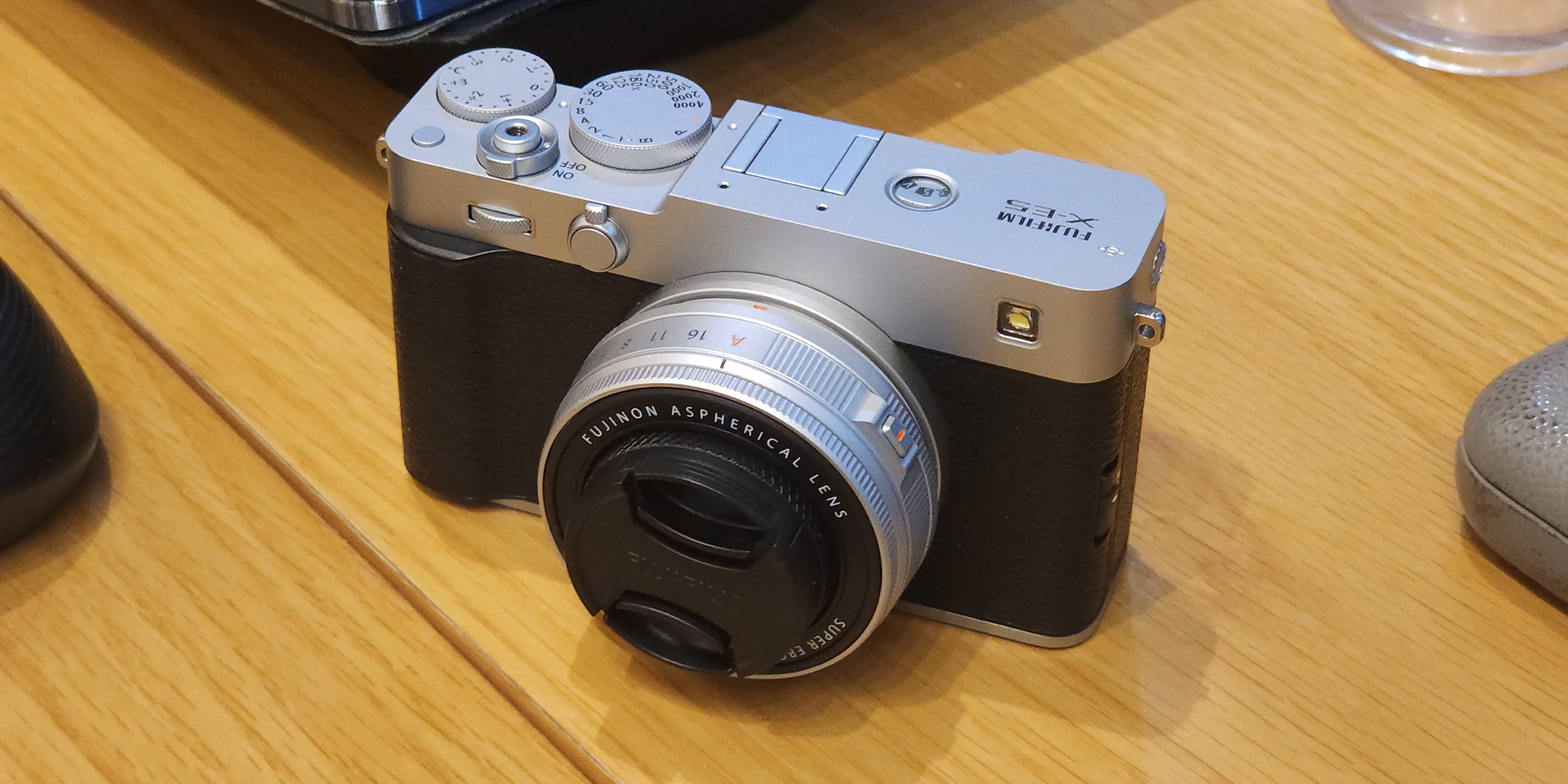 Took this at a café, as usual
Aside from the color, it’s broadly similar to the Sony A7C. Compactness is the defining keyword, it goes for an RF-style body instead of the typical DSLR form, and in detail, it even has a small 2.36-million-dot EVF — just like the A7C. The EVF magnification is 0.62x, nearly identical to the A7C’s 0.59x.
The Positives
Fujifilm cameras tend to be regarded as a brand that compensates for lacking specs with emotion and sensibility, but the spec sheet actually shows solid fundamentals. Even just listing the improvements over my previous Sony A7C on a 1 basis:
| Sony A7C | Fujifilm X-E5 |
|---|---|
| 24.2MP | 40.2MP |
| Electronic front-curtain shutter | Full mechanical shutter |
| 5-stop image stabilization | 7-stop image stabilization |
| Up to 4K 30FPS | Up to 4K 60FPS |
| 2 custom buttons | 4 custom buttons |
| 509g body weight | 445g body weight |
The most noticeable improvement is the full mechanical shutter. No need to worry about quality issues like rolling shutter or bokeh clipping. The X-E5 also supports the existing electronic shutter and electronic front-curtain shutter modes alongside the full mechanical shutter, giving it an unconditional advantage over the A7C — and this alone makes it feel like a more complete camera.
Other satisfying elements are the image stabilization and the increased number of custom buttons. Both were insufficient on the A7C. The image stabilization in particular was so unreliable on the A7C that even at 1/60s, I’d frequently get blurry shots — whereas with the Fujifilm X-E5, I can get usable photos even at 1/30s.
Updated 2026-02-21!
- After several more months of use, the retro design feels like this camera’s biggest strength. Not just because it’s pretty. Paired with a small, light prime, it draws no more attention than a smartphone — so I can walk around with the camera slung over me without raising suspicion. That means better accessibility for photography.
- The 40.2MP high resolution has been a huge help. Cropping by 2x — that is, down to 1/4 the area — doesn’t feel forced at all. That’s a freedom I never felt with 12MP or 24MP photos.
The Negatives
On the flip side, the areas where it falls short, also 1:1:
| Sony A7C | Fujifilm X-E5 |
|---|---|
| 2280mAh | 1260mAh |
| Weather sealing | No weather sealing |
| 5.94µm pixel pitch | 3.04µm pixel pitch |
| AF reliability high | AF reliability average |
| Wide lens selection | Limited lens selection |
Among these, the battery is a bit of a dealbreaker. At 1260mAh, it’s roughly half the capacity of the NP-FZ100 battery used in the Sony A7C, which is objectively low. Looking at recent releases like the Sony RX1R III, you can see that similar design constraints exist due to physical limitations — it’s somewhat unavoidable — but still, I can’t help being taken aback by how quickly the battery drains in practice.
The next point worth raising is the lack of weather sealing. This was the single biggest factor that made me question whether this camera was really the right choice. Even though the body alone costs 2.049 million won at retail — a mid-to-high-end camera in 2025 — it lacks weather sealing that the similarly positioned X100VI and the competing models in the same price range, the X-T5 and X-T50, all have. The camera probably won’t break anytime soon, but it’s a concern.
Updated 2026-02-21!
- The AF is definitely frustrating. Many reviews say Fujifilm cameras have improved to a usable level by the 5th generation, but that “usable” assessment seems to be a subjective opinion from people who’ve been using cameras for a very long time. Personally, I felt it was worse than even a budget smartphone.
Notable Points
Design and Build Quality
The first thing you notice is the design. Beyond being a good-looking camera, the X-E5 has several points that set it apart from other cameras. The aluminum-machined top plate stands out. It’s a cheaper material than traditional magnesium alloy, but it’s beautiful — like looking at an Apple or Bang & Olufsen product — and when you touch it, it conveys a proper metallic feel.
The shutter speed dial, unlike previous models like the X-E4, X100VI, and X-Pro 3, is fully exposed rather than recessed into the body, giving it a geometric impression. At the same time, there’s no hairline finish or excessive dials — the minimalist philosophy is well preserved, keeping a clean look. This is something you’d typically only find on Leica M and Q series cameras, and considering that the recently released Leica M EV1 features an electronic viewfinder, they feel quite close to each other.
But one thing — the protruding grip portion is, to me, a flaw in an otherwise perfect design. While it does offer stability when holding the camera, the design feels less complete compared to the clean look of the predecessor X-E4 or the Nikon Z fc. I wish they had sold an optional add-on grip like the previous model — that would have kept things cleaner.
Updated 2026-02-21!
The aluminum-machined body looks really nice on the surface, but it doesn’t feel solid. Compared to the commonly used magnesium alloy, it feels like paper-thin — and that actually undermines reliability. Think of it like holding a MacBook.
Classic Display
The new viewfinder interface mode introduced in the X-E5 is very satisfying. It leverages the 5th-generation body’s 40MP high-resolution sensor to simulate the experience of OVF-equipped cameras, where you can see the area outside the frame in your peripheral vision. Technically, it’s just a simple crop — similar to 2x zoom or APS-C mode on full-frame cameras — but Fujifilm has reinterpreted it beautifully.
Combined with the digital teleconverter that lets you crop at 1.4x and 2x, you can come remarkably close to replicating an RF camera shooting experience. The X-E5’s high-resolution headroom means a 1.4x crop still yields a meaningful ~20.5MP, and a 2x crop yields about 10MP — so the penalty is minimal. The focal lengths that pair well with this feature are roughly as follows:
| 1x APS-C Focal Length | 1x 35mm Equivalent | 1.4x 35mm Equivalent | 2x 35mm Equivalent |
|---|---|---|---|
| 18mm | 27mm | 37.8mm | 54mm |
| 23mm | 34.5mm | 48.3mm | 69mm |
| 35mm | 52.5mm | 73.5mm | 105mm |
As I’ll discuss later, this is why the XF 23mm F2.8 R WR, released alongside the X-E5, is sold as a kit lens. At 1x, 1.4x, and 2x, the 35mm equivalent focal lengths become 35mm, 50mm, and 70mm respectively — perfect. This is a similar approach to the X100VI, which partially compensates for the limitations of a prime lens, and except for the 0.8-stop difference in minimum aperture, the shooting experience is nearly identical.
Film Simulations
Film simulation is practically Fujifilm’s identity, but I was skeptical about it. Technically, it’s just a preset for tone curves and color values, and the results are quite different from actual film. Plus, if you enjoy the process of professionally color-grading RAW files like I do, the concept of a fixed color palette isn’t inherently appealing.
But after using it, I found it works well as a lightweight JPEG straight-out-of-camera option, and the results themselves look quite nice. Imagining that a film roll manufacturer had directly translated their own product’s color science made it pretty fun to use. I only vaguely knew about Fuji Recipes as a way to customize settings, but the degree of customization — grain, white balance, tone curve, sharpness, noise reduction — is quite generous, which makes film simulation incredibly versatile.
There’s also the fun of finding and applying recipes created by others on Fuji Weekly. Since the X-E5 is a 5th-generation body, I used X-Trans V Recipes and tried out some appealing ones like California Summer and Kodak T-Max 100 Soft Tone. It’s not quite “convincingly film-like,” but it’s distinctive and enjoyable.
Questionable Design Choices
The viewfinder sensor being placed very close to the film simulation dial is the most obvious design flaw. Every time I change the film simulation, the proximity triggers the EVF to turn on. This means I can’t easily operate the dial with my left hand, which is closer — I have to carefully use my right hand, which is farther away. If the sensor had been on the left side of the viewfinder, there would be no issue. It was likely a space constraint or an oversight in the design.
The tactile feel of the dials isn’t firm enough by my standards. The shutter speed dial, exposure compensation dial, and film simulation dial all have different resistance levels. The film simulation dial in particular feels a bit loose — the tactile feedback is like touching paper and cardboard.
XF 23mm F2.8
This lens has clear strengths and weaknesses. The strengths are what they are, but the weaknesses are just as significant — that’s the problem. The fundamentals — build quality, handling, resolution — are solid, but the AF holds it back from being an emotional favorite. Every time it focuses, the outer barrel physically moves and produces loud mechanical noise. It’s so bad that it’s hard to believe this is a 2025 lens — it’s a major drawback for video use.
Inevitably, the comparison point is other brands’ lenses. The comparable primes in Sony’s E-mount — the SEL35F28Z or the G trio — meet the minimum standard in every respect. And that makes it even more disappointing, because the strength of this lens is real: from F2.8, you get distortion-free, low-chromatic-aberration resolution that handles the 40.2MP sensor well. I don’t understand why they didn’t put enough care into the AF module design.
Closing Thoughts
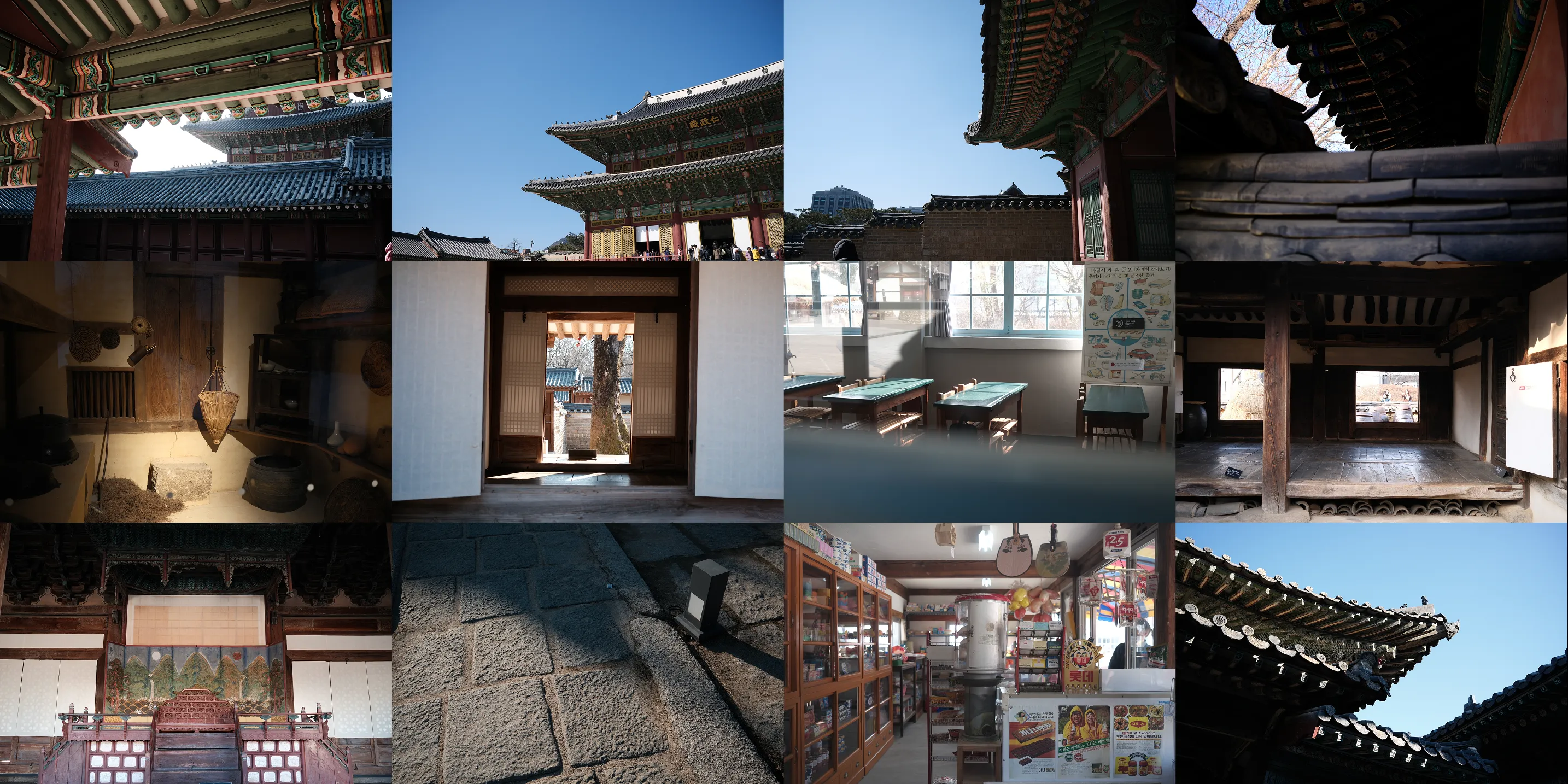 Changgyeonggung, Changdeokgung, and the National Folk Museum. Raw, unfiltered snapshots.
Even after generous searching, finding decent lenses for the X-E5 is difficult. I can now understand why so many people use the TTArtisan 27mm F2.8 — despite it not being that great a lens. Looking for lenses that suit the X-E5, there are almost none. I relied heavily on SonyAlphaBlog’s Which Lenses are best for A6xxx – Part 1: Introduction & Summary, which I used to reference often when I had Sony gear, and I also diligently looked into MTF charts and various reviews for native lenses. The following caught my attention:
-
Native
- XC 13-33mm F3.5-6.3
- XF 16-50mm F2.8-4.8 R LM WR
- XF 23mm F2 R WR
- XF 23mm F2.8 R WR
- XF 50mm F2 R WR
-
Third-party
- Sigma 18-50mm F2.8
- TTArtisan 50mm F2
- 7Artisans AF 35mm F1.4
Meanwhile, after four months of use, I’m starting to get a feel for where this camera stands. To conclude, it’s somewhere between neutral and disappointed. To summarize my experience: “it’s definitely fun to use, but it’s a bit of a soft camera in some ways.” It can replace the Sony A7C in terms of size, weight, and emotion, but it falls notably short in image quality and reliability. Given that this is a comparison between a 2020 and a 2025 camera, the gap with recent full-frame cameras is probably even larger.