Sony A7C Review from a Smartphone Photographer's Perspective


Looking for a Camera to Replace My Smartphone
Technical discussion ahead!
I’ve been feeling the limits of smartphone photography. The biggest issues are the fixed focal lengths, and the lack of detail and dynamic range. My current S22 Ultra is a smartphone known for its camera strengths — with four cameras and a whopping 108 megapixels — but the smartphone form factor imposes the following limitations:
- The S22 Ultra only supports four focal lengths in full-frame equivalent: 13mm, 23mm, 69mm, and 230mm. Both 35mm and 50mm — what would be called standard focal lengths — are missing.
- RAW output is limited to 12MP for the wide and ultrawide, and 10MP for both telephoto lenses, which is a bit low. The 108MP wide-angle cannot output RAW.
- Both telephoto sensors and lenses are underwhelming. The sensor is tiny at 1/3.55”, the lenses are dark at F2.4 and F4.9, and the quality is soft — not even fully utilizing the 10MP.
So the more I took photos with my smartphone, the more disappointed I felt. That’s when I started looking into proper cameras. After considering various models like the Sony A7 IV, ZV-E10, A6400, and Lumix S5, I decided on the Sony A7C as a full-frame camera with decent value for money in 2025.
So I Bought It, But Then
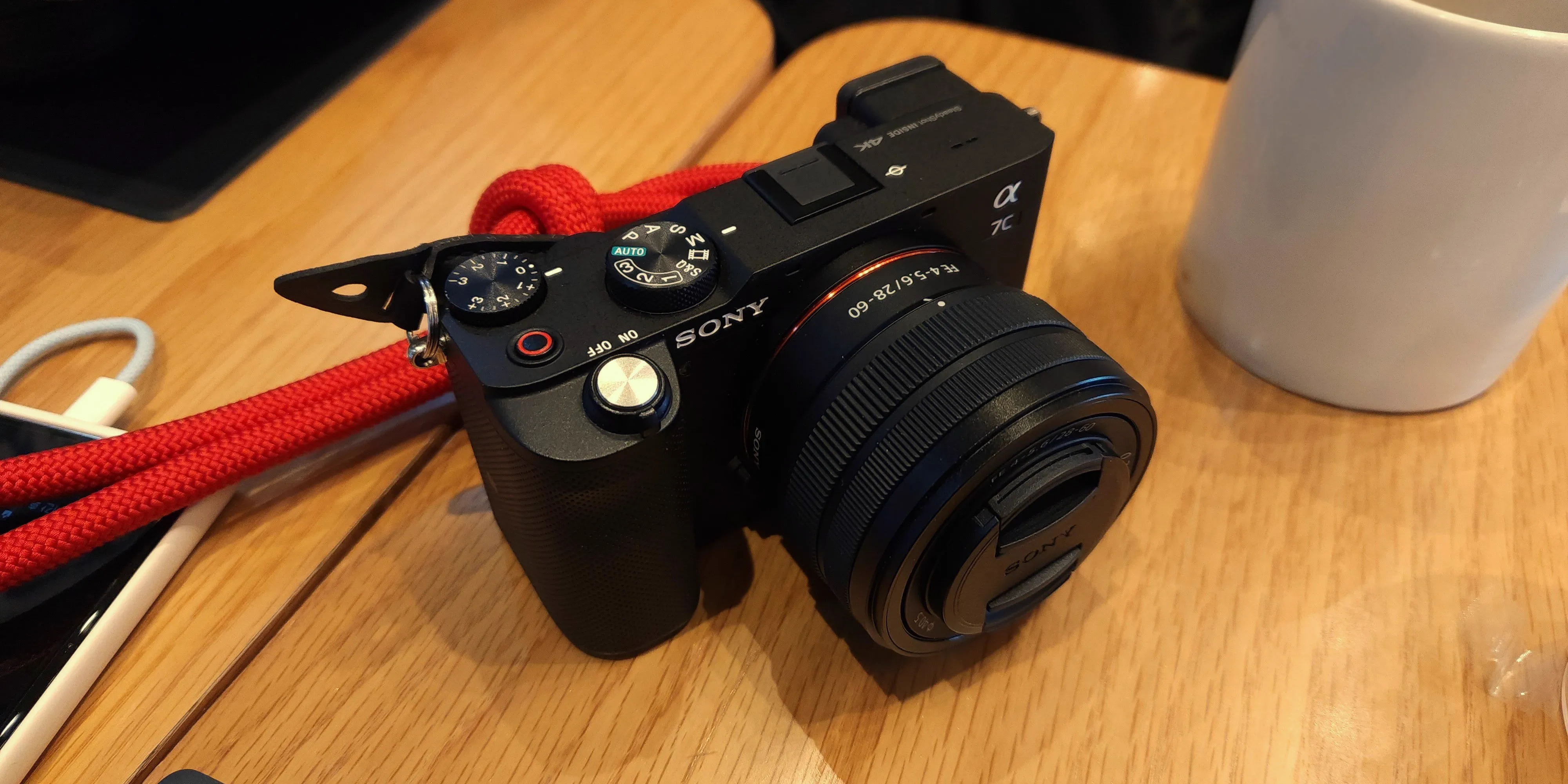
As a year-end gift to myself, I bought a used Sony A7C. My first impression after handling it was that it’s quite heavy and weighty. Even though it’s marketed as a light and compact full-frame camera, the body without a lens still felt substantial enough to use as a brick — not light at all, and still burdensome.
I quickly got my hands on the SEL2860 kit lens and took some photos with high expectations, but the results were rather ordinary compared to what I’d hoped. Perhaps because the kit lens has a slow aperture, the smartphone took much brighter shots at the same ISO and shutter speed. When I adjusted the ISO to match the exposure, the photos had noticeable noise, so the difference wasn’t as big as I expected. The photos were definitely better than what my smartphone could produce, but the bokeh and detail weren’t overwhelming. I was disappointed.
The shooting experience itself also wasn’t as uniquely different from a smartphone as I’d expected. The fundamental process — spotting a scene or subject you like, composing the shot, and pressing the shutter — remains essentially the same. What differs is that a camera uses physical buttons and lets you use an electronic viewfinder, but that experience didn’t feel indispensable for taking good photos.
There were even aspects that were less convenient than a smartphone camera. For a device released in 2020, the LCD screen quality isn’t great, the bezels are very wide, and the screen is small — requiring more concentration to compose shots compared to a smartphone. Touch controls are limited, and the software response feels a beat slow; for example, the level gauge doesn’t respond immediately. Even if I’m not going to watch Netflix or play games on the camera, having such a vastly different user experience from the smartphone in my hand was a bit jarring.
Still, just as a product often shows disappointing sides right after you get it, only to gradually reveal its true value with use, I decided that the first step was to take it out and use it in various places. I also thought that since the SEL2860 lens has a very slow aperture, I might not truly understand the camera until I try it with other lenses.
No Regrets, but More Disappointing Than I Expected
The truth is, looking at recent smartphone development trends, traditional camera companies are getting heavily involved in the mobile camera market — to the point where you have to wonder if you even need to buy a dedicated camera. OnePlus phones ship with Hasselblad branding, and Xiaomi and vivo are putting actual Leica Summilux or ZEISS lenses on their devices. Sony’s Xperia line emphasizes AF performance, mobile-specific Creative Looks, and other camera features accumulated from Sony Alpha.
This was my biggest concern. A proper full-frame camera, given its size, is burdensome for casual everyday use. So I kept thinking it might make more sense to just import a flagship smartphone from overseas when I need better camera performance.
From that perspective, I’m not sure if casually carrying a camera around town is still an ideal approach, and I haven’t yet felt that this camera produces clearly superior photos — possibly due to the disappointing lens. That’s worrying, but since I haven’t used it enough, I’ll have to keep using it to find out whether it meets my expectations.
After Actually Using It, It’s Better Than I Thought
Updated 2025-06-09!
Because over the past six months, I’ve tried several other lenses — the SEL35F28Z, SEL2070G, and others. To cut to the chase: using a full-frame camera is very different from taking photos with a smartphone. In my experience, they’re so different that it’s hard to put them in the same comparison group.
- What I found satisfying about the A7C as a full-frame camera:
- The dynamic range is very wide, and the exposure latitude is excellent. At first glance, 24.2 megapixels is only twice the area of a smartphone’s 12MP, but with a good lens, it delivers more than twice the detail improvement. More precisely, you feel like every pixel is being fully utilized.
- Depending on the lens you pair it with, the potential is substantial. In fact, I think the lens determines the final image more than the camera body does. This is easy to overlook since smartphones don’t have interchangeable lenses.
- Compared to a smartphone, these aspects remain inconvenient:
- The camera and lens combination is large and heavy, making it very inconvenient to carry. It’s essentially like carrying a 1kg dumbbell with an unstable center of gravity around your neck or in your hand.
- In a similar vein, a large, heavy camera draws a lot of attention from others on its own. The contrast is striking — smartphones are completely free from this problem.
The problem is that these downsides don’t just end at “it’s a bit inconvenient.” Making a conscious effort to bring a large, heavy camera with you isn’t easy. It takes up far more space in your bag than a laptop or tablet, and the whole process of taking it out and putting it back is cumbersome. When you endure the hassle and take photos, the quality turns out quite good and you feel satisfied — but then when you try to bring the camera out again, the fatigue creeps in.
The A7C, or more broadly any full-frame camera, offers an awkward experience compared to a smartphone. You can’t just pull it out of your pocket anytime, but you trust the results. It’s big, heavy, and you can’t take it out just anywhere — but that trust barely makes it worth sacrificing the empty space in your bag.