Reading Meditations: Marcus Aurelius' To Himself
About the Book
| Item | Details |
|---|---|
| Title | To Himself (Τὰ εἰς ἑαυτόν) |
| Author | Original work by Marcus Aurelius, translated and annotated by Kim Jae-hong |
| Publisher | Minumsa |
| First Edition Release Date | July 31, 2023 |
The Roman Philosopher-Emperor’s Notebook
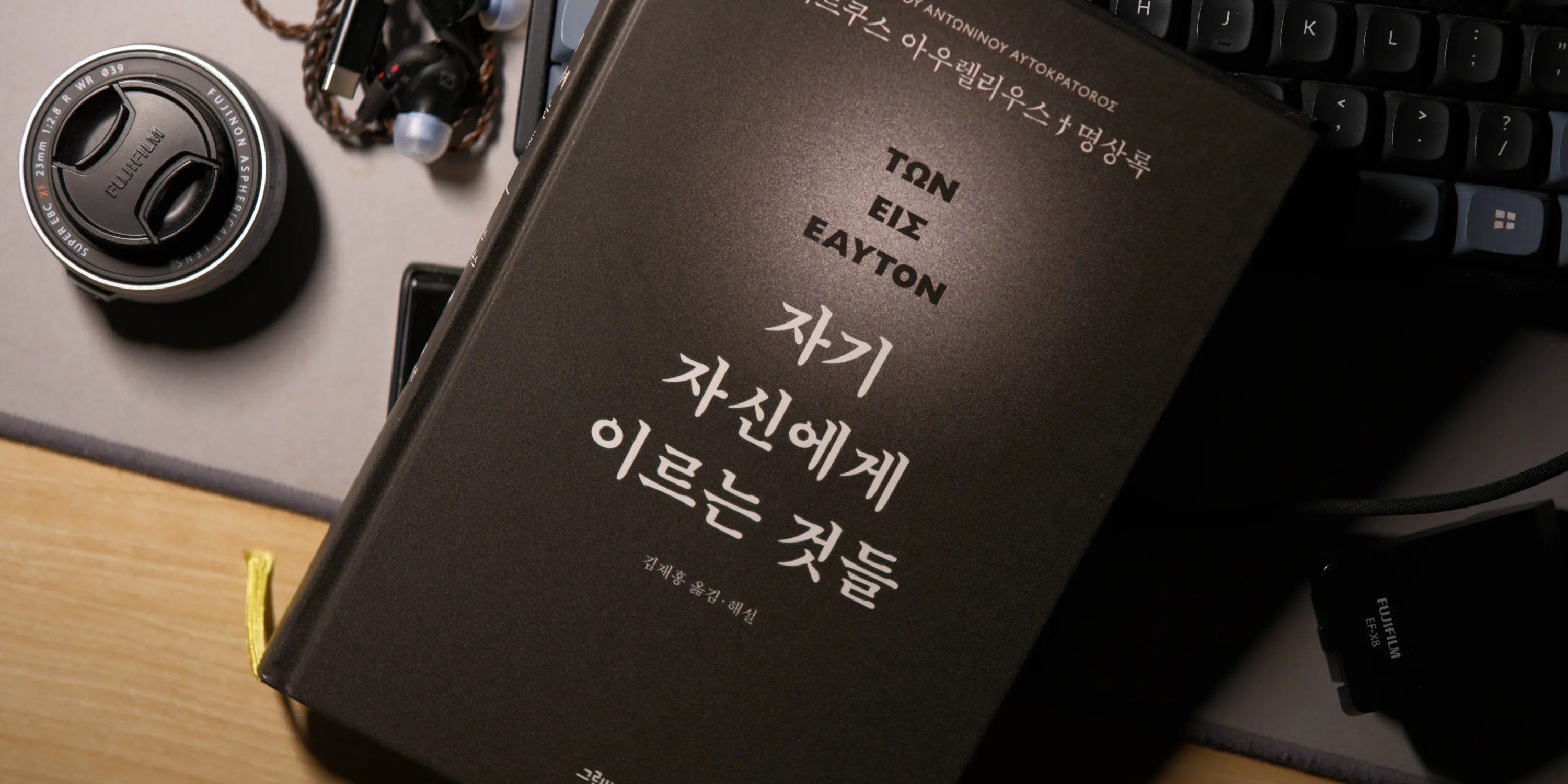
The Korean title of the book is “자기 자신에게 이르는 것들” (Things That Reach Oneself), but since it is widely known as Meditations (명상록), I will use Meditations throughout. To be honest, given how long ago the original was written, I was wary of the Meditations brand itself. First, I worried that, just as the techniques or subjects of very old creative works feel dated, ancient philosophy might also feel disconnected from modern sensibilities. Second, I had preconceptions from criticisms that the fact it was written by a Roman emperor may have led to overvaluation, and from Bertrand Russell’s point that the content lacks coherence.
So I opened the first page with nothing more than a general expectation for a classic, and I read it with great satisfaction. It was unexpectedly enjoyable. Meditations was written around 170 CE, when the rational legacy of ancient Greece was deeply rooted in the Roman Empire, and Stoic reflection is the core that runs through this book. The content is built on concepts that modern people would rarely arrive at on their own, and it felt fresh. While there were parts I found ambiguous and aspects open to criticism, I was fundamentally able to entrust my mind to the book and read along.
The book repeatedly reveals the Stoic philosophical perspective: a life that does not violate natural law, a life that fully feels the lightness of human existence while being conscious of the impact of death, a life as a Roman grounded in the governing reason. At the same time, it strives to apply an attitude of humility, diligence, substance, self-reflection, and tolerance. In particular, it mostly deals with subjects one might have pondered at least once in daily life while digesting them through a philosophical lens. Following that gravity was rewarding not only because it offered an indirect experience of the Stoic school that might otherwise be just a line in a history textbook, but also because its sublimity evoked a certain sense of shame, which carried considerable meaning. I could unexpectedly feel the stark gap between the mindset of a modern person today and the perspective of a Roman emperor from two thousand years ago, and I could realize just how snobbish and short-sighted my approach to life had been. Rather than describing that feeling in words, I think it can be better expressed by summarizing the key Stoic ideas as follows.
A Stoic Insight on Death
Though thou shouldst be going to live three thousand years, and as many times ten thousand years, still remember that no man loses any other life than this which he now lives, nor lives any other than this which he now loses. The longest and shortest are thus brought to the same. For the present is the same to all, though that which perishes is not the same; and so that which is lost appears to be a mere moment.
Death is such as generation is, a mystery of nature; a composition out of the same elements, and a decomposition into the same; and altogether not a thing of which any man should be ashamed, for it is conformable to the nature of a reasonable animal, and not contrary to the reason of our constitution.
I consider the passages dealing with conclusions about death to be the highlight of this book. The biggest reason I chose Meditations was precisely because it addresses this topic, and it shows an obsession that lives up to that expectation, almost to the point where I wondered, “Why is this person so skeptical about life?” The content is mainly about “why we should be conscious of death” and “how small our lives are in the face of death,” but the development was so blunt and concrete that many emotions flooded in at once. There was a pleasant surprise at finding thoughts I had once entertained echoed here, a wistfulness about the fate that humans across all ages and cultures inevitably fall into this kind of anguish, and a sense of letdown that, across such a long history, there has unfortunately been no overwhelming rebuttal to this simple point.
To dismantle the fear of death, Marcus connects two lines of argument. One is the Stoic view that death takes away only the present. The past has already passed, and the future has not yet arrived—neither exists. If so, death takes away only the present moment, and has no effect on the past or future. This ties into the second perspective. In this view, death is merely a natural phenomenon on the same level as thunder or lightning. As Epictetus argued, death is no different from harvesting an ear of grain, a leaf falling, a fig becoming a dried fig, or a grape becoming a raisin. Thus, contrary to common belief, treating it as ominous is as absurd as being afraid of a natural phenomenon that occurs every day. Whether this perspective on reality is correct for the 21st century is a separate question, but the reasoning is clear and refreshing.
However, what Marcus Aurelius says has a different context from common phrases like “What’s the point of living?” or “This too shall pass.” If those sayings illuminate the futility of life through long induction, Marcus’s view leans toward intellectualism, a deduction that one should therefore live a better life. The translator summarizes this as: “Marcus’s acceptance of the shortness of human life is not an admission of nihilism—the view that everything is ultimately meaningless—but rather a way to reveal that becoming a virtuous person as quickly as possible is urgent.”
If thou strip off thy judgments concerning things that seem most worthy of admiration and praise, and consider their bare bodies, how soon they lose their value, and how poor they are. For if thou wert to be living three thousand or ten thousand years, remember that no man loses any other life than this which he now lives, nor lives any other than this which he now loses. The longest and shortest are thus brought to the same. A limit of time is fixed for thee, which if thou dost not use for clearing away the clouds from thy mind, it will go and thou wilt go, and it will never return.
So the argument is to focus on the present, neither the future nor the past. More specifically, it is close to the point that regret over the past and vague anxiety about the future hinder the practice of virtue we must perform right now, so we should focus on the present. Through this, Marcus emphasizes that the value of life is not proportional to its length. In the end, it is a passage that well depicts the Stoic duty: even if the quantitative time of life is left to fate, one’s attitude and spirit toward that time must be determined by oneself.
I recall saying to several acquaintances three years ago, half-jokingly and half-seriously, “The best life is to take a fatal dose of drugs and die, because you can have the happiest death.” Most of them thought about it and showed agreement, but what I felt then was not relief at their agreement, but a sense of puzzlement: “Does everyone understand life merely as a means to happiness?” Now I am a bit clearer. The premise that simply living a long life is not the core task of life seems to have been shared by ancient people, including Emperor Marcus, 1,900 years ago.
Make the present time a gift to thyself. They who prefer to hunt for posthumous fame do not consider that the men of after time will be such as these whom they cannot bear now; and both are mortal. And what is it after all that it should weigh upon thee, whatever noise they make or whatever opinion they form about thee?
A refreshingly shocking sentence. What we commonly hear are things like “history will judge you” or “don’t you fear history?” But Marcus—whether from personal opinion or a Stoic perspective—argues that the notion of living to build moral merit and achievements for posthumous evaluation is also unnatural. His reasoning is that future generations are no more than ordinary humans, equally flawed, equally prejudiced, and destined to die and disappear someday, just like the people of today. This shows just how high the intensity of Meditations is. Before Meditations, I had encountered similar arguments in optimistic nihilism, Cynicism, and the like. And seeing this same point repeated in this book was both fascinating and unsettling. Even if they are right, it is more realistic to assume otherwise and respect each person’s life. I worry that this might excessively devalue human life.
If thou art pained by any external thing, it is not this thing that disturbs thee, but thy own judgment about it. And it is in thy power to wipe out this judgment now. It is shameful for the soul to give way first in this life when the body does not give way. But if the obstacle is beyond thy strength, do not lament, for if life without that action is not worth living, thou mayest depart from it with goodwill.
However, he evaluates suicide negatively. And it is worth noting that his reasoning is not based on the common life-affirming idea that “life is the most precious thing humans possess, and casting it away is extremely foolish.” On this point, the translator’s footnote is quite interesting and worth quoting. Epictetus said: “But what matters is this: remember that the door is open. Do not be more fearful than children. Just as children say, ‘I don’t want to play anymore’ when the game is no longer fun, and then leave, you too must depart. Yet, if you stay, stop lamenting.” In other words, suicide as a choice, not as an escape, is a perfectly viable alternative, and there is nothing strange about it.
Marcus’s Inclusive Values
Accustom thyself to attend carefully to what is said by another, and as far as possible enter into the soul of the speaker. But when thou seest a man, look at once at what manner of man he is, and then it will be manifest that thou needest not be troubled by his opinion. Nevertheless, be of goodwill toward him, for by nature men are friends to one another.
The second quotation in particular struck me as especially central to this book. Marcus consistently emphasizes listening to what others have to say throughout Meditations. Yet he does not advocate unconditional acceptance. Based on the Stoic premise that all people are the same rational beings, he argues that even if someone is speaking nonsense, one should first closely examine the circumstances and context that gave rise to that opinion. This was similar to a thought I had always held, so it offered some comfort. Specifically, I had held roughly the following view: “No matter how outrageous an opinion may seem, the person expressing it perceives the same world through the same sensory organs and interprets it through the same cognitive processes as I do. So rather than dismissing them as erroneous or ignoring them, it is better to acknowledge them as a fellow human and try to persuade them.”
For example, I think we should thoroughly examine the circumstances that led a criminal to choose murder, rape, arson, or smuggling, the cause of a political extremist’s beliefs, and the motivation that allowed someone to jump from a high-rise building. Setting aside any feelings of repulsion, we should trace their lives back in time and follow them closely. But in my personal experience, when I put forward the perspective of “Shouldn’t we do this?” to those around me, most were not interested in making such an effort, and regarded it not as necessary empathy but as tiring concession. I often got the impression that people prefer to dismiss something as a person’s peculiar disposition rather than trying to understand the principle behind their actions. It was one of the everyday dissonances I felt, and receiving even a small piece of advice on it was comforting.
To the jaundiced honey tastes bitter, and to those bitten by mad dogs water causes fear; and to little children the ball is a fine thing. Why then am I angry? Dost thou think that a false opinion has less power than the bile in the jaundiced or the poison in him who is bitten by a mad dog? Men exist for the sake of one another. Teach them then or bear with them.
However, these parts invite criticism. Earlier he says to enter into the soul of others and understand them, but here he compares others to the sick and ends with “teach them or endure them”—the attitude is different. These sentences are certainly about inclusion in that they preach communal duty. Yet if one intends to use jaundiced and rabid people as metaphors for real situations, there is a danger of dismissing anyone who holds a different opinion as someone with jaundice or rabies. Although such things do happen in the world, the phrasing is highly suggestive and somewhat radical. The gist is that there is no need to get angry at someone with jaundice or rabies, but there is a difference between an attitude of understanding and an attitude of enduring.
Insights Across All Ages and Cultures
Remember that all is opinion. For what was said by the Cynic Monimus is manifest: and manifest too is the use of what was said, if a man receives what may be got out of it as far as it is true. Take away thy opinion, and then there is taken away the complaint, “I have been harmed.” Take away the complaint, “I have been harmed,” and the harm is taken away.
This passage brings to mind the Buddhist concept of “一切唯心造” (all things are created by the mind). In fact, even apart from Buddhism, ancient philosophies seem to consistently point out that human standards are ultimately illusory. One thing I have come to feel strongly recently is that we perceive and interpret reality through our bodies. Good and bad, and the satisfaction and suffering that come from them, are inherently subjective, originating from each person’s value judgments, and those judgments are usually based on peripheral matters. Of course, this is not to say that we should deny each person’s perception of reality. But doubt is necessary. From this perspective, there are times when one’s own intuition must be contradicted.
According to the translator’s notes, Marcus was a person who felt the pressure to become a good person before his time ran out. That is why he seems to have focused on ensuring that the time allotted to him would not be misused, by quickly freeing himself from distractions and steadily enjoying life. If so, his argument that one should readjust one’s perspective before feeling distress arises from the same principle as his earlier point about how meaningless it is to be conscious of others’ evaluations. Regardless of the principle, it is remarkable that such a line of reasoning existed more than two thousand years ago.
No man can harm thee unless thou choosest to be harmed; thou art harmed only when thou thinkest thyself harmed.
I found it exhilarating that one sentence defeats a part of the modern tendency to calculate everything in terms of profit and loss. Looking at recent social trends, it seems we prioritize how to distribute work equally and what can be called fair over serious discussion of cooperation. These are necessary discussions, but fixating on who gains and loses is exhausting—especially because it is merely subjective value judgment. Of course, this passage was probably not intended to say that one should unconditionally compromise on the harm they perceive or suppress feelings of anger, frustration, and unfairness. Rather, it felt closer to meaning that one should transcend a victim mentality and act rationally based on facts. If so, this can also be connected to the following:
One man, when he has done another a kindness, is ready also to reckon on a return. A second is not ready to do this, but yet in his heart of hearts ranks the other as a debtor, and he is conscious of what he has done. But a third is in a manner not conscious of it, but is like the vine that has borne a cluster of grapes, and when it has once borne its due fruit looks for no reward beyond.
When I read this, I passed over it thinking, “Well, that’s obvious,” but after closing the book and returning to daily life, I found myself recalling this sentence often. Whenever I had the opportunity to be a good person, and whenever I could receive something in return for my goodwill, I gradually reflected on whether I was placing myself in the position of a creditor. What Marcus points out is a fundamental perspective on human relationships. One does not have to be devoted without expectation of return, but for a good deed to remain a good deed, one must be devoted without expectation of return.
Closing the Review
The Marcus I perceived was, paradoxically, as self-centered as he was humble, yet his emphasis on an inclusive attitude did not feel hypocritical. He tries to respect and include all human beings as rational beings and part of a community, while also acknowledging the harsh realities that cannot be avoided—an inevitable tension. The significance of Meditations lies in its treatment of the balance between these two poles.
One additional point: the expressions are mostly abstract—“intellect,” “thought,” “ability,” “vice,” “possibility,” “will,” “curse,” “praise,” “regret,” and so on—which made it difficult to grasp the exact intent. The nuances of the original Greek text must have been inevitably distorted in translation, and since I cannot study classical Greek, it was somewhat regrettable that I could not be confident about the meanings I understood. At the same time, when I closed the book, a feeling of emptiness and wistfulness washed over me—“It’s already over.” I was able to understand that famous figures of ancient Greece whom I had casually thought of in passing—Epicurus, Socrates, Diogenes—are weighty giants in human history. The density of thought and the breadth of content are considerable, so I think I will be able to read it more deeply when I open it again at an older age.
Structurally, the annotations are very rich, and it is enjoyable to follow them and flesh out the context. Following the flow the translator discovered, you may be surprised at how consistently Marcus repeats the same arguments. As a side note, Plato’s Symposium, Phaedo, and Apology are frequently referenced in the annotations—books I had noted down while choosing this one. Reading Meditations sparked further interest, and I suspect I might acquire them someday.