Reading The Art of War: All the Strategies and Tactics of the World
Due to Korean copyright law concerns, I cannot translate and publish direct quotations from Korean-language source texts. Just as I would not want my own writing to be freely translated and distributed without permission, I respect the same for others. Therefore, while the Korean original includes excerpts from the books, the foreign language versions replace direct citations with summaries of the authors’ arguments.
About the Book
| Item | Details |
|---|---|
| Title | The Art of War |
| Subtitle | All the Strategies and Tactics of the World |
| Author | Original work by Sun Wu, compiled and written by Im Yong-han |
| Publisher | Kyobo Book Centre |
| First Edition Release Date | January 28, 2025 |
A Humanities Book, Not Just a Military Treatise
Although the book is titled The Art of War, it is not a simple translation but a work in which the historian Im Yong-han adds lengthy commentary to Sun Tzu’s brief propositions, giving the impression that it assumes a reader who already has a certain level of prior trust in the Art of War brand. The scope of the book is roughly broad and shallow, but that does not mean its depth is objectively shallow. Rather, its breadth overwhelms its depth—Hannibal, Napoleon, Lee and Grant, Patton, Qin Shi Huang, Yu Jagwang, Sejong and Sejo, and countless historical commanders and monarchs pass through its pages, alongside Rome and ancient Greece, the Kingdom of Jerusalem, Imperial France, Nazi Germany, the United States during the Civil War, and numerous Chinese dynasties in periods of division and unification. The explanations are fairly accessible, but the sheer scope of content can quickly tire a reader unfamiliar with world history. If unfamiliar material appears, you need to take your time and read slowly.
The writing style is dry, and traces of effort to maintain neutrality in handling the subject matter can be seen throughout. The book is divided into major and minor chapters, and each minor chapter proceeds in the flow of original text citation, the author’s interpretation, historical examples, and concluding remarks. The process of tracing the original text’s true intent is well-executed, but the historical citations are excellent in both quality and quantity and form the core of the book. “In this era, in this region, the warring factions of the conflict were such and such, their power and justification were such and such, what tactics were planned by which commander, how the battle actually unfolded, and what the outcome and significance of the war were. This example supports Sun Tzu’s intent.” This kind of detailed, well-placed description conveys the compiler’s interpretation effectively.
With such abundant citations, the path to each conclusion is varied, and following that flow was itself enjoyable. For example, in the chapter on Form (形), the book introduces the original text of the Han dynasty bamboo slip manuscript discovered in 1972: “守則有餘, 攻則不足 (in defense there is surplus; in attack, there is insufficiency)” and points out that due to interpretive difficulty, this sentence was later transformed into “守則不足, 攻則有餘 (when strength is insufficient, defend; when strength is abundant, attack).” It notes that even in Cao Cao’s annotated Art of War—the earliest commentary—the latter form appears, but introduces the anecdote of Emperor Taizong of Tang (Li Shimin) and his military strategist Li Jing (李靖), who found this annotated version puzzling and created yet another interpretation. The chapter then begins its main argument by convincingly pointing out the semantic awkwardness of the widely known “守則不足, 攻則有餘.”
The Art of War deals with detailed strategies for leading a collective to victory while consistently emphasizing how powerless humans can become before circumstances and what mindset one should adopt in such circumstances. Thus, rather than praising individual strength and myth, both the original author and the compiler advise realistically assessing one’s environment and, if at a disadvantage, learning to adjust it in one’s favor. For example, in the opening chapter on Planning (計), the compiler criticizes number-dependency. It is not anti-intellectualism—numbers do tell us something, but they do not tell us everything, leaving room for misjudgment—so one must reach a level of not just grasping reality but extracting it. Similarly, even if uncontrollable variables account for 90% and what can be controlled accounts for only 10%, one should not leave the outcome to heaven but should use that one-tenth of independent variable to shape reality.
The Significance of the Humanities in Modern Society
Throughout, the compiler’s perspective, when citing the original text, consistently emphasizes why one should adopt a pragmatic attitude and that realizing such an attitude comes through a deep understanding of people and context. This flow is what allows the book to maintain its identity as a military treatise while also possessing the character of a humanities work. Im Yong-han’s Art of War neutrally deduces Sun Tzu’s intent from the first chapter on Planning (計) through the thirteenth chapter on The Use of Spies (用間), while consistently drawing out abstracted perspectives from it. What stands out is the compiler’s frequent social critiques in each chapter. This can be distracting if one wishes to directly feel the deeper meaning from the pure original text of The Art of War, but for the most part, the content is fundamentally necessary and timely given the nature of the book, so I was able to read through it without issue. To give a few examples of what personally stood out to me from the thoughts the compiler seeks to convey through The Art of War:
The compiler argues that discovering why a certain method led to victory requires insight into human and social nature, which is why corporations emphasize the humanities. But he criticizes corporate humanities education as trend-driven—boosted during good economic times, replaced by practical training during downturns. He insists the humanities are neither a leisure luxury nor character education, and argues that prioritizing practical training during crises is like doubling down on obsolete skills amid change.
Or,
The compiler criticizes performance-oriented training across society, arguing that training must involve experimentation and the ability to handle the unexpected. He rejects the counterargument that intangible elements cannot be fairly evaluated, comparing it to the difference between pre-modern and modern science—the real distinction lies in whether one addresses only the visible or also the invisible.
And,
The compiler argues that winning in diplomatic warfare requires setting aside past grudges and focusing on reality and future value. While everyone knows the saying about no eternal enemies or allies, he observes that emotions and prejudice take precedence, especially when people claim a “special history” exempts them from this principle. He counters by noting that many countries have endured far worse and still moved forward.
To add a comment on the last quotation: In the chapter on Attack by Stratagem (謀攻), when discussing the interpretation of “eliminating diplomacy,” the compiler points out that Germany and France inflicted immense damage on each other through two world wars, yet today they have put aside the past and transformed into a cooperative relationship when needed, and that they are actually benefiting each other. The compiler argues that this is a desirable development. Although this may sound like a biased opinion at first glance, the compiler persuades the reader by emphasizing that The Art of War was written during the chaos of the Spring and Autumn and Warring States periods for the pursuit of pragmatism and efficiency. The book’s frequent commentary functions as one of its charms in this context.
Closing
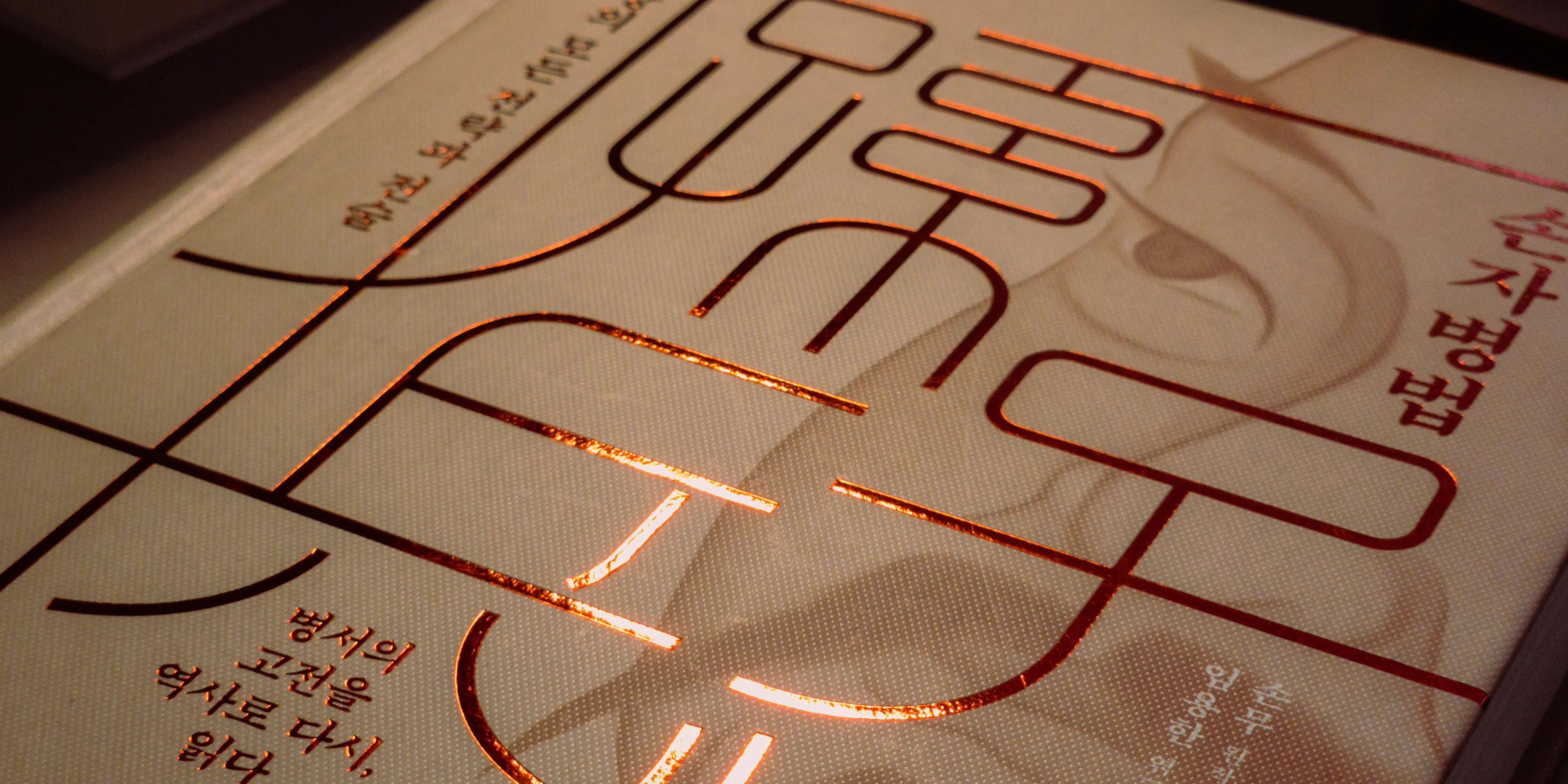
Personally, there was much that I only understood with difficulty, and the content is not light, so I think I will need to read it two or three more times. On a note outside the content: although the book costs around 20,000 won, which is reasonable, my satisfaction grew the more I familiarized myself with it. This is not simply because it is hardcover with a clean design, but for several specific points. The title “손자병법 (孫子兵法)” written in seal script on the cover shines in an intense, warning-like shade of wine red depending on the angle of light, adding to the weight of The Art of War. Each chapter’s length is deliberately calibrated for a sense of separation—every chapter ends on a left-hand page, and the next chapter begins on a right-hand page. When you turn a page, the entire left side is filled with a reddish-brown margin, and the new main text begins on the right. Among the books I own, the attention to detail was remarkable.